
- Where Are Coach Bags Made Today?
- Are Coach Bags Made in China?
- Why Does Coach Manufacture Products in Different Countries?
- How Can You Tell Where a Coach Bag Was Made?
- What Are Coach Bags Made Of?
- Coach Signature Canvas vs. Traditional Cotton Canvas
- What Bag Brands Can Learn From Coach’s Manufacturing Model
- How to Develop Your Own Custom Canvas Bag Line
- Manufacturing Original Custom Bags With Biben
- FAQs About Where Coach Bags Are Made
- Conclusion: Where Are Coach Bags Really Made?
Coach is an American fashion brand founded in New York City, but its products today are manufactured through an international supply chain rather than primarily in the United States.
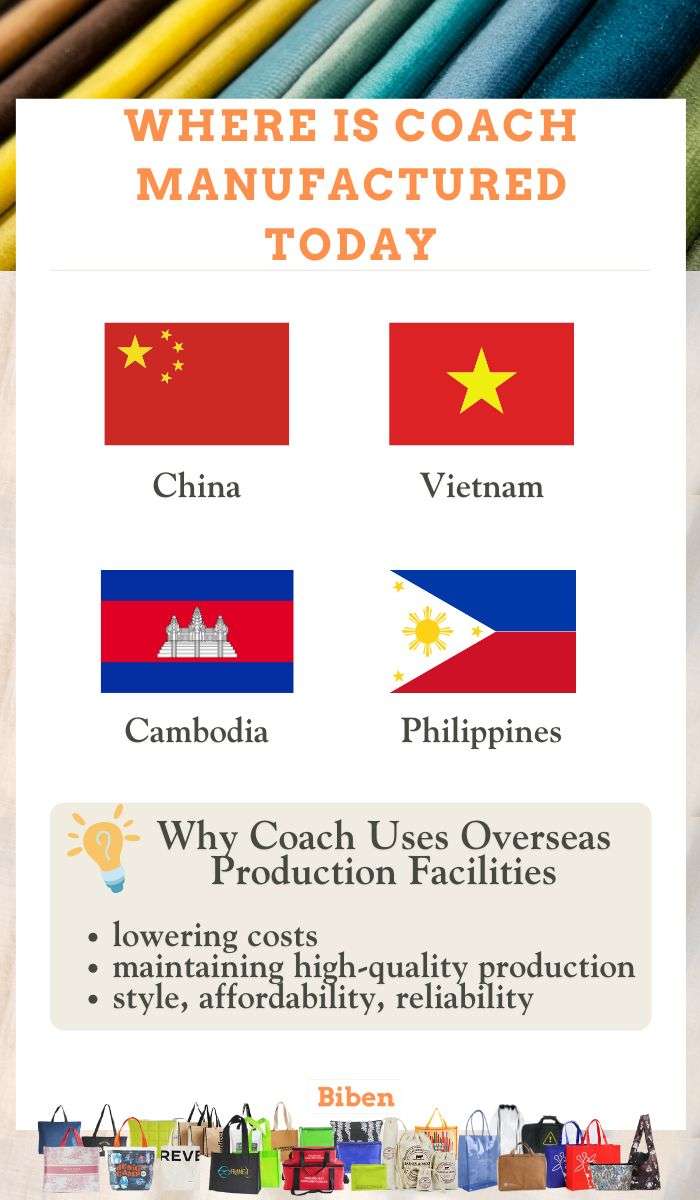
So, where are Coach bags made? According to Tapestry’s fiscal 2026 Form 10-K, the primary manufacturers of Coach products were located in Vietnam, Cambodia, the Philippines, and India. The wording matters: this is a company-level disclosure covering Coach products overall, not a statement that every Coach handbag is manufactured in one of those four countries.
China also has an important place in Coach’s manufacturing history. Earlier Tapestry filings identified mainland China among the primary manufacturing locations for Coach products. That helps explain why authentic older Coach bags may carry a “Made in China” country-of-origin label even though China is not included in the latest list of primary manufacturing countries.
For shoppers, collectors, and brands researching handbag production, there is another important distinction: where a brand is based, where its materials come from, and where a finished bag is manufactured are not necessarily the same place.
This guide looks at Coach’s current and historical manufacturing footprint, how to identify the manufacturing origin of an individual bag, what Coach bags are made of, and what emerging brands can learn from this type of global manufacturing model.
Where Are Coach Bags Made Today?
The most reliable current answer comes from Coach parent company Tapestry.
In its fiscal 2026 Form 10-K, Tapestry reports that the manufacturers of Coach products were primarily located in Vietnam, Cambodia, the Philippines, and India.
The same filing explains that Tapestry uses independent manufacturers while maintaining oversight of key raw-material selection and monitoring compliance with quality-control standards through on-site inspections at manufacturing facilities.
This makes Coach a useful example of how a global fashion brand can separate brand ownership and design direction from physical manufacturing. Coach remains a New York-founded American brand, while production is supported by an international network of independent manufacturers.
| Country | Manufacturing Context | What Buyers Should Know |
|---|---|---|
| Vietnam | Current primary location | Listed by Tapestry among primary Coach product manufacturing locations |
| Cambodia | Current primary location | Listed in the latest corporate manufacturing disclosure |
| Philippines | Current primary location | Continues to be part of Coach’s primary manufacturing network |
| India | Current primary location | Included among primary locations in recent Tapestry filings |
| China | Historical manufacturing location | Appeared among primary Coach manufacturing locations in earlier filings |
| United States | Brand origin | Coach was founded in New York, but the U.S. is not listed among current primary manufacturing locations |
This table should not be interpreted as a complete country-of-origin database for every Coach handbag ever produced. Tapestry uses the word “primarily,” and its disclosure covers Coach products at the brand level rather than identifying the manufacturing location of every individual SKU.
Are Coach Bags Made in Vietnam?
Yes, Coach products are manufactured in Vietnam.
Vietnam is specifically identified in Tapestry’s latest fiscal 2026 filing as one of the primary locations of manufacturers producing Coach products. It also appeared in previous filings, indicating that Vietnam has been an established part of Coach’s international manufacturing network.
However, it would be too broad to say that all Coach bags—or a specific Coach collection—are manufactured in Vietnam. For the origin of an individual handbag, the information attached to that particular product is more relevant than a brand-level country list.
Are Coach Bags Made in Cambodia?
Cambodia is also one of the primary manufacturing locations identified by Tapestry for Coach products.
It has appeared consistently in recent company disclosures alongside Vietnam and the Philippines.
As with Vietnam, the corporate filing does not break down which individual Coach handbag models, materials, or collections are assigned to Cambodian manufacturers. Claims that a particular country specializes exclusively in certain Coach materials or bag categories should therefore be treated cautiously unless supported by product-specific information.
Are Coach Bags Made in the Philippines?
Yes. The Philippines is another current primary manufacturing location for Coach products according to Tapestry.
It has been part of the company’s disclosed manufacturing network for multiple fiscal years.
The presence of several manufacturing countries illustrates an important point about modern bag production: a global brand does not necessarily depend on one country or one factory for every product category.
Are Coach Bags Made in India?
India is included in the latest list of primary locations for Coach product manufacturers.
It was also included in Tapestry’s fiscal 2025 disclosure, together with Vietnam, Cambodia, and the Philippines.
However, the company-level disclosures do not support assuming that all Coach products made in India belong to a particular category, such as men’s bags or leather accessories. Without product-specific evidence, it is more accurate simply to identify India as part of the current primary manufacturing network.
Are Coach Bags Made in China?
Yes, Coach has historically manufactured products in mainland China, but China is not listed among the primary manufacturing locations for Coach products in Tapestry’s latest fiscal 2026 disclosure.
This distinction is important because search results about Coach manufacturing often mix information from different years.
For example, Tapestry’s fiscal 2020 Form 10-K identified the primary manufacturers of Coach products as being located in Vietnam, Cambodia, the Philippines, and mainland China. By fiscal 2023, Tapestry’s reported primary Coach manufacturing locations were Vietnam, Cambodia, and the Philippines. More recent FY2025 and FY2026 disclosures include India alongside those three countries.
The manufacturing network has therefore changed over time.
That also means an older genuine Coach bag carrying a “Made in China” label should not automatically be considered suspicious simply because China does not appear on the newest primary-manufacturing list.
Does “Made in China” Mean a Coach Bag Is Fake?
No. A “Made in China” label by itself does not mean that a Coach bag is counterfeit.
Tapestry’s historical regulatory filings provide direct evidence that mainland China was previously one of the primary locations for manufacturers producing Coach products.
At the same time, the opposite is also true: a country-of-origin label saying China, Vietnam, Cambodia, India, or the Philippines does not prove that a bag is genuine.
Manufacturing location is only one piece of product information. It should not be treated as a standalone authentication method.
Why Does Coach Manufacture Products in Different Countries?
Coach is not unusual in using a geographically distributed supply chain.
Tapestry describes its manufacturing strategy as one designed to optimize a combination of cost, lead times, and construction capabilities. It also reports maintaining sourcing management offices that work with its independent manufacturers.
That offers a more accurate explanation than simply saying fashion brands manufacture overseas because labor is cheaper.
For a complex bag collection, manufacturers may need to handle different combinations of leather, textiles, coated materials, lining, metal hardware, zippers, edge finishing, reinforcement, stitching, printing, and assembly. A brand therefore needs suppliers capable of reproducing defined specifications consistently across production runs.
Supply-chain diversification can also reduce dependence on a single manufacturing country. The exact sourcing strategy of an individual brand can change as costs, trade conditions, supplier capabilities, capacity requirements, and business priorities change.
For independent brands developing their own products, the same principle applies on a smaller scale: the lowest factory quotation is not the only variable that determines whether a manufacturer is suitable.
Material expertise, sampling accuracy, construction capability, communication, quality control, and consistency during bulk production all matter.
How Can You Tell Where a Coach Bag Was Made?
If you want to know where a particular Coach bag was manufactured, look for the country-of-origin information associated with that individual product rather than relying only on a general online list of Coach manufacturing countries.
Depending on the product and production period, relevant information may appear on an interior tag, label, or other product marking.
This is more precise than assuming that every Coach bag from a certain collection came from the same country.
It is also important to separate three questions:
Where is Coach from?
Coach is an American brand founded in New York City in 1941.
Where are Coach products manufactured?
Tapestry currently identifies Vietnam, Cambodia, the Philippines, and India as the primary locations of manufacturers of Coach products.
Where was this particular Coach bag manufactured?
Check the country-of-origin information on that specific product.
These answers can all be different without contradicting one another.
Can a Coach Serial Number Tell You Where the Bag Was Made?
A serial or style number should not be treated as a universal country-of-origin decoder.
Coach has used different identification and labeling systems across different periods and products. Product identifiers can be useful when researching a style, but determining where a particular item was manufactured is better based on the origin information actually provided on that item.
Similarly, a serial or style number alone should not be presented as definitive proof that a bag is authentic.
What Are Coach Bags Made Of?
There is no single “Coach bag material.”
Coach’s collections use different combinations of leather, coated canvas, jacquard textiles, fabric linings, recycled polyester, and other materials depending on the product.
This is particularly important when discussing Coach canvas bags, because “canvas” can refer to substantially different material constructions.
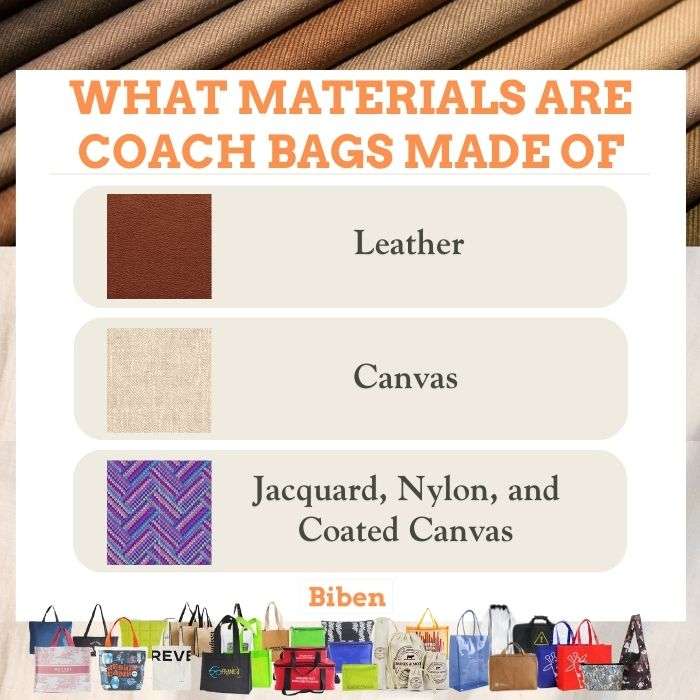
Leather
Leather remains closely associated with Coach’s product identity, but individual products can use different types and combinations of leather.
For example, current Coach product specifications include materials such as refined calf leather, smooth calf leather, glovetanned leather, and pebble leather across different designs.
Leather may also be combined with textile or coated materials rather than forming the entire bag.
From a manufacturing perspective, leather selection affects more than appearance. Thickness, surface finish, flexibility, edge treatment, reinforcement, stitching, and the intended bag structure all need to work together.
That is why simply requesting a “leather bag” is not a complete manufacturing specification.
What Is Coach Signature Canvas?
Coach Signature Canvas is a coated canvas material featuring the brand’s recognizable Signature motif.
This is an important correction to the common assumption that every product described as a Coach canvas bag is made from ordinary cotton canvas.
Current Coach product pages identify products such as the Plaza Bag as being made from Signature coated canvas and refined calf leather, while other Signature Canvas styles combine coated canvas with smooth leather and fabric or recycled-polyester linings.
Coating changes the surface characteristics of the underlying material and creates a very different product from a basic uncoated cotton canvas tote.
What Is Coach Signature Jacquard?
Coach Signature Jacquard is different from Signature coated canvas.
Jacquard is a woven textile in which the design is created through the fabric construction rather than simply applied as a surface print.
Coach currently describes its Signature Jacquard as a woven material, and some current products specify a blend of recycled polyester and regenerative cotton.
The distinction matters because coated canvas and woven jacquard behave differently during cutting, sewing, pattern alignment, edge finishing, and assembly.
A brand developing its own textile handbag should therefore specify the actual material construction rather than simply telling a manufacturer that it wants “canvas.”
Nylon and Other Textile Materials
Coach also uses other textiles and mixed-material constructions across its broader collection.
The key lesson is that the material listed in a product name does not necessarily describe every component of the bag. A product can combine a main exterior material with leather trim, textile lining, reinforcement, hardware, and other components.
For manufacturers and buyers, the complete bill of materials is therefore more useful than a broad category such as “canvas bag.”


Coach Signature Canvas vs. Traditional Cotton Canvas
For brands researching Coach canvas bags as inspiration for material strategy, one of the most useful distinctions is between coated Signature Canvas and conventional cotton canvas.
They are not interchangeable.
| Feature | Signature Coated Canvas | Traditional Cotton Canvas |
|---|---|---|
| Basic concept | Coated material used in Coach Signature products | Woven cotton textile |
| Surface | Coated/finished surface | Natural woven textile surface |
| Branding | Coach’s proprietary Signature identity | Can support a brand’s own original print, embroidery or logo treatment |
| Texture | More finished surface character | Visible textile weave |
| Manufacturing | Requires construction compatible with the finished material | Weight, weave, sewing and reinforcement can be selected for the intended bag |
| Typical development use | Coach-branded products | Custom totes, retail bags, promotional bags and original fashion designs |
For a new brand, traditional cotton canvas offers substantial room for original product development. Fabric weight, weave, color, handles, lining, pockets, closures, embroidery, printing, and hardware can all influence the finished result.
But developing an original canvas collection does not mean reproducing Coach’s Signature C motif, logos, proprietary graphics, or other protected branding.
The more useful lesson is to study how established brands coordinate material, construction, hardware, proportions, finishing, and consistent visual identity—then create a distinct design system for your own brand.
What Bag Brands Can Learn From Coach’s Manufacturing Model
Coach’s manufacturing network illustrates something that smaller brands sometimes overlook: a bag is not defined by its country of manufacture alone.
A specification-driven manufacturing process matters more.
Before approaching a bag manufacturer, a brand should ideally define the product’s intended use, dimensions, structure, main material, lining, handles or straps, closures, hardware, branding method, colors, and packaging requirements.
Consider a canvas tote as an example.
Two bags can both be described as “canvas totes” while being very different products. One might be an unlined promotional tote with printed branding. Another could use heavier canvas, an internal lining, reinforced handles, zipper closure, internal pockets, custom hardware, and structured panels.
The material category is the same, but the manufacturing requirements—and resulting cost and appearance—are not.
Material Selection Should Follow the Product’s Purpose
A retail shopping bag, fashion tote, cosmetic pouch, event giveaway, and reusable grocery bag should not automatically use the same material specification.
Cotton and canvas can provide a natural textile appearance. RPET recycled polyester offers another option for brands considering recycled synthetic materials. Tyvek has a distinctive lightweight, paper-like appearance, while PP woven construction is commonly relevant where a structured reusable shopping-bag format is required.
The correct choice depends on the intended structure, appearance, branding method, expected use, quantity, and target cost.
Construction Details Matter as Much as the Main Fabric
For custom bag development, buyers should look beyond the exterior fabric.
Handle attachment, seam construction, reinforcement, zipper installation, lining, pocket construction, hardware placement, edge finishing, and print alignment can all influence how the final bag performs and looks.
A technically clear sample is therefore valuable before bulk manufacturing because it gives both buyer and manufacturer a physical reference for the agreed specification.
Branding Should Be Original
Established brands such as Coach demonstrate the value of a consistent visual language, but that does not mean a new brand should reproduce an established company’s monogram or signature pattern.
Instead, develop your own logo system, colors, artwork, print repeat, labels, hardware details, and packaging.
This gives the product a recognizable identity that belongs to your business rather than making it look like an imitation of another brand.
How to Develop Your Own Custom Canvas Bag Line
If your research into Coach manufacturing is ultimately part of finding a supplier for your own bag project, start with a product specification rather than a reference photo alone.
1. Define the Bag Structure
Decide what you are actually manufacturing.
Is it a retail tote, shoulder bag, pouch, reusable shopping bag, drawstring bag, promotional bag, or another structure?
Specify approximate dimensions and the intended contents. These decisions affect material choice, reinforcement, handles, closures, and internal construction.
2. Select the Material
Choose materials according to the product rather than simply requesting “Coach-style canvas.”
For an original custom line, options may include cotton, canvas, RPET recycled polyester, Tyvek, washable kraft paper, PVC composite materials, or other application-specific fabrics.
If you want a particular hand feel, stiffness, texture, appearance, or surface finish, communicate that requirement during material selection.
3. Define Your Own Branding
Prepare original artwork and determine where branding should appear.
Depending on the material and design, branding can involve printing or other appropriate decoration methods. Color matching and placement should be confirmed as part of the product specification rather than left until bulk production.
4. Confirm the Sample and Specifications
A sample helps convert drawings and written requirements into a physical product.
Check dimensions, proportions, fabric appearance, stitching, handles, pockets, closures, hardware, logo position, colors, and overall construction before approving the bulk specification.
If changes are needed, record them clearly so the approved version becomes the production reference.
5. Prepare for Bulk Production
Once the product specification is confirmed, production requirements should clearly document the approved material, construction, branding, dimensions, quantity, and other relevant details.
For custom projects, MOQ and production requirements can vary according to material, structure, printing, and customization complexity.
Manufacturing Original Custom Bags With Biben
Biben is a Chinese manufacturer specializing in customized shopping bags and promotional packaging bags, with more than 10 years of manufacturing experience.
Rather than reproducing another brand’s proprietary design, Biben works with businesses developing their own customized bag products.
Available material categories include natural cotton, canvas, RPET recycled polyester, Tyvek, washable kraft paper, PVC composite materials, PP woven materials, and other options suited to different bag applications.
Customization can cover the bag structure, material selection, logo printing, surface finishing, and color matching. Product categories range from reusable shopping and promotional bags to cosmetic zipper pouches, apparel totes, insulated bags, mesh bags, foldable bags, and other custom structures.
For many customized designs, typical minimum order quantities are approximately 500–1,000 pieces, depending on the product and specification.
For brands researching premium bags such as Coach, the most useful approach is not to copy the finished product. Instead, identify what you value about the product—its material combination, organization, structure, proportions, functionality, or finishing—and translate those observations into an original specification suitable for your own brand.

FAQs About Where Coach Bags Are Made
Where are Coach bags made?
According to Tapestry’s fiscal 2026 Form 10-K, manufacturers of Coach products were primarily located in Vietnam, Cambodia, the Philippines, and India. This is a brand-level disclosure covering Coach products generally, so it should not be interpreted as a complete country list for every individual Coach bag.
Is Coach made in China?
Coach products have historically been manufactured in mainland China. Tapestry’s fiscal 2020 filing included mainland China among the primary manufacturing locations for Coach products. However, China is not included among the primary Coach manufacturing locations disclosed for fiscal 2026.
Are Coach bags made in Vietnam?
Yes. Vietnam is currently one of the primary locations of manufacturers producing Coach products according to Tapestry’s latest annual filing.
Are Coach bags made in India?
India is also listed as a current primary manufacturing location for Coach products. The public company disclosure does not, however, specify that every particular type of Coach bag is manufactured there.
Are Coach bags made in the USA?
Coach is an American brand founded in New York, but the United States is not listed among the primary manufacturing locations for Coach products in Tapestry’s fiscal 2026 disclosure. Brand origin and manufacturing origin should therefore be treated as separate concepts.
Does “Made in China” mean a Coach bag is fake?
No. Historical Tapestry filings confirm that mainland China was previously a primary manufacturing location for Coach products. A Chinese country-of-origin label alone therefore does not establish that a bag is counterfeit.
How can I tell where my Coach bag was made?
Check the country-of-origin information provided on the individual item, such as its relevant interior label or tag. This is more reliable for determining the origin of a specific product than assuming every Coach bag from a collection was manufactured in the same country.
What are Coach bags made of?
Coach bags use multiple materials depending on the product. Current Coach product specifications include various leathers, Signature coated canvas, Signature jacquard, textile linings, recycled polyester, and mixed-material constructions.
What is Coach Signature Canvas?
Coach describes Signature Canvas as a coated canvas material featuring its recognizable Signature motif. Individual products often combine Signature coated canvas with leather and textile linings.
Is Coach Signature Canvas the same as cotton canvas?
No. Coach Signature Canvas is described by Coach as coated canvas, while conventional cotton canvas is a woven textile material. Brands developing custom canvas bags should choose materials according to their own product requirements rather than assuming the two constructions are equivalent.
Conclusion: Where Are Coach Bags Really Made?
So, where are Coach bags made?
The most current public answer is that Tapestry identifies Vietnam, Cambodia, the Philippines, and India as the primary locations of manufacturers producing Coach products in fiscal 2026. Coach is an American brand with New York roots, but its modern manufacturing model is international.
China remains relevant to the story because it was part of Coach’s primary manufacturing network in earlier periods. As a result, an older Coach bag marked “Made in China” is not automatically counterfeit simply because China does not appear on today’s primary-manufacturing list.
The bigger lesson is that manufacturing country alone tells you relatively little about the complete product. Material specifications, construction, workmanship, quality-control requirements, and the brand’s management of its supply chain all contribute to the finished result.
The same principle applies when developing an original bag line.
Instead of searching for a factory that can simply “make a Coach-style bag,” define what your own product needs to achieve. Choose the structure, material, dimensions, handles, closures, internal organization, branding, colors, and finishing around your target customer and brand identity.
For businesses developing an original canvas, cotton, reusable, promotional, or custom packaging bag collection, Biben can support material selection and customized bag development from specification through bulk manufacturing. Prepare your design, target dimensions, preferred material, branding requirements, and estimated quantity to begin evaluating the right manufacturing solution for your project. Contact us today!
More Post :
TSA Approved Quart Size Bag for Liquid — Custom PVC Pouches That Promote Your Brand in Every Journey
Custom Shopping Bags – Find the Perfect Customized Bag for Your Business with Biben

Author: Gary — Founder of Biben Packaging
With a decade of leadership in the custom packaging industry, Gary has built Biben Packaging into one of China's most trusted manufacturers of reusable and sustainable shopping bags. His deep expertise in materials, printing, structural design, and scalable production allows him to guide brands toward cost-effective and eco-friendly packaging solutions.